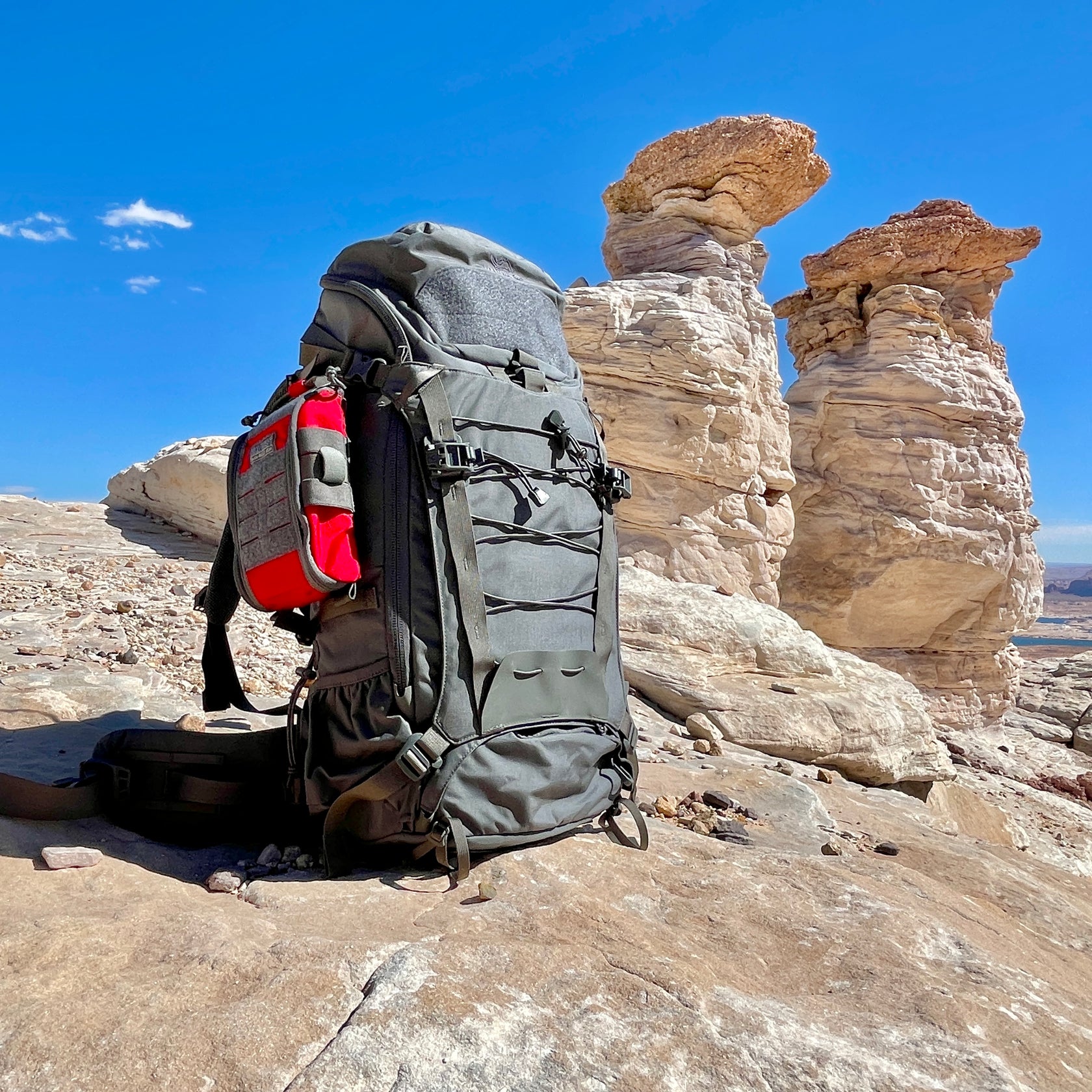


Ask ten people what an IFAK is and you'll get ten different answers — a bag of Band-Aids, a "military first aid kit," or something only soldiers need. None of those are right. An IFAK is a specific, purpose-built answer to a specific problem: stopping a person from dying of a survivable injury in the minutes before professional help arrives. This guide explains exactly what an IFAK is, where the concept came from, what belongs inside one, and why the case for owning one has nothing to do with whether you wear a uniform.
What Does IFAK Stand For?
IFAK stands for Individual First Aid Kit. The word "individual" is the important part. An IFAK is not a family boo-boo kit or a shared cabinet of supplies — it is a compact, self-contained kit carried by one person and intended, first and foremost, to treat that person. In tactical medicine there is a hard rule behind this: your IFAK is for you. A responder treats a casualty using the casualty's own kit whenever possible, so their own gear is preserved for their own emergency.
That single design principle drives everything else about an IFAK. It has to be small enough to carry every day, organized so its contents can be found under stress, and stocked with the specific tools that address the injuries most likely to kill quickly. It is a trauma kit, not a comfort kit. If you want to understand the distinction in detail, we cover it in IFAK vs. First Aid Kit: What's the Difference — the short version is that a standard first aid kit manages minor, non-life-threatening problems, while an IFAK manages the ones that end lives in minutes.
Where the IFAK Came From: A Military Origin
The modern IFAK is a product of hard-won battlefield lessons. For most of military history, the leading cause of preventable death in combat was massive hemorrhage — bleeding out from an arm or leg wound that, with the right intervention applied fast enough, was entirely survivable. Analysis of casualty data made this brutally clear: soldiers were dying not from unsurvivable injuries, but from survivable ones treated too slowly or not at all.
Out of that data came Tactical Combat Casualty Care (TCCC), a set of evidence-based guidelines developed in the 1990s that reordered the priorities of battlefield medicine around what actually kills people first. TCCC pushed life-saving tools — above all, the modern tourniquet — down to the individual level, so every service member carried the means to stop their own bleeding. The kit that held those tools became standardized issue: the Individual First Aid Kit. When you see an IFAK today, you are looking at the civilian descendant of that program.

What's Inside an IFAK? The MARCH Framework
An IFAK is not a random assortment of supplies. Its contents map directly onto the priorities TCCC teaches responders to address, in order, using the memory aid MARCH. Each letter is a category of life threat, sequenced from the thing most likely to kill you first to the thing that can wait:
- M — Massive Hemorrhage. Catastrophic bleeding is the top priority because it kills the fastest. This is why a quality Combat Application Tourniquet (C-A-T) and hemostatic or packing gauze anchor every serious IFAK. A limb bleed can drain a person in minutes; a tourniquet applied high and tight buys the time an ambulance needs to arrive.
- A — Airway. An unconscious casualty can lose their airway. Basic IFAKs address this with positioning and, in more advanced kits, a nasopharyngeal airway.
- R — Respiration. Penetrating chest wounds can collapse a lung. A vented chest seal such as the HyFin Vent Compact Chest Seal covers the wound while allowing trapped air to escape, managing an open or tension pneumothorax.
- C — Circulation. Once major bleeding is controlled, circulation is monitored and shock is managed — keeping the casualty warm and still.
- H — Hypothermia (and Head injury). A bleeding casualty loses heat fast, and cold blood clots poorly. Preventing heat loss with an emergency blanket is a genuine life-saving step, not an afterthought.
A well-built IFAK gives you at least one tool for each early letter of MARCH, plus the ancillaries that make them work under pressure — gloves, trauma shears, a permanent marker to note tourniquet time, and a compression bandage. For a full walkthrough of how these interventions are actually performed, see our pillar guide, Trauma First Aid: The Complete Guide to Bleeding Control.
Basic vs. Advanced: Not All IFAKs Are the Same
IFAKs scale. A minimalist everyday-carry kit and a fully-loaded duty kit are both legitimately "IFAKs" — they simply sit at different points on a spectrum of capability, size, and required training.
A compact, pocket-sized kit is built to solve one problem well: get a life-saving tool onto a wound now, wherever you happen to be. The Pocket ACE IFAK is designed around exactly this idea — a slim, modular pouch you can actually keep on you every day, because the best trauma kit is the one you have when it matters, not the one sitting in a closet at home.

At the other end, a comprehensive kit built into a rugged organizer platform carries a broader range of interventions for the person willing to train on them. The AID-PAK is that kind of kit — a full trauma loadout in a VANQUEST FATPack platform, suited to a vehicle, a range bag, or a home base station. Between these two extremes sit the rest of our compact kits and pre-built stocked kits. If you're not sure which tier fits your situation, our kit comparison chart lays the options side by side.
Who Actually Needs an IFAK?
The honest answer is: far more people than carry one. Life-threatening bleeding does not check for a uniform. Car accidents, industrial and workshop injuries, kitchen and power-tool lacerations, hunting and recreation mishaps, and acts of violence all produce the exact injury an IFAK is built to treat — and all of them happen to ordinary people, often far from immediate professional help.
The uncomfortable reality is that the average emergency response time in the United States is several minutes, and severe arterial bleeding can be fatal in less than that. When those minutes are the whole game, the only medicine that matters is whatever is already on scene. That is the entire argument for an IFAK: it puts a proven intervention in the hands of the person who is guaranteed to be there — you, or the person standing next to you. Commuters, parents, tradespeople, outdoor enthusiasts, teachers, and anyone who spends time away from a hospital all have a rational case for carrying one.
Owning the kit is only half of it. An IFAK you don't know how to use is a false sense of security. Pair the gear with real instruction — a Stop the Bleed course is free, short, and widely available — so that when you reach for the kit, your hands already know what to do.
Frequently Asked Questions
Is an IFAK the same as a first aid kit?
No. A conventional first aid kit is stocked to handle minor, non-life-threatening problems — cuts, blisters, headaches, minor burns. An IFAK is a trauma kit built around the injuries that kill within minutes: massive hemorrhage, airway compromise, and chest trauma. They solve different problems, and ideally you own both.
Is it legal to carry an IFAK?
Yes. The core components of an IFAK — tourniquets, chest seals, gauze, bandages — are legal for civilians to purchase and carry in the United States. They are medical supplies, not controlled items. As always, using them effectively is a matter of training, not permission.
Do I need training to use an IFAK?
You should get it. Some interventions, like applying a tourniquet, are simple enough to perform correctly after brief instruction, but performing them fast and without hesitation under stress takes practice. A Stop the Bleed or TCCC-aligned course is the fastest way to turn a kit you own into a kit you can actually use.
What is the single most important item in an IFAK?
The tourniquet. Massive hemorrhage from a limb is the most common preventable cause of death from trauma and the one an individual can most reliably fix on the spot. A quality, name-brand tourniquet — not an unproven imitation — is the non-negotiable core of any serious IFAK.
Where should I keep my IFAK?
Somewhere you can reach it in seconds, ideally on your person or within arm's reach. A kit locked in a trunk or buried in a backpack defeats the purpose. Many people run a compact everyday-carry IFAK on their belt or in a bag and keep a larger kit in the vehicle or at home.
Disclaimer: This article is for educational purposes only and is not a substitute for professional medical care or certified training. Seek qualified instruction (e.g., Stop the Bleed, TCCC) before relying on any trauma equipment.
Mentioned in this article
More stories

Vented vs. Non-Vented Chest Seals: Which Should Be in Your Kit?