
HUNT
Scenario Guide — Hunters
IFAK for
Hunters
You're miles from a road, hours from a hospital. Broadhead lacerations, accidental gunshot wounds, and chainsaw cuts don't wait for EMS. A properly stocked hunter's IFAK can be the difference between bleeding out in the backcountry and making it home.
Backcountry ready
MARCH protocol
NAR-sourced components
HSA / FSA eligible
The problem
Average EMS response in rural areas is 18–30 minutes. Arterial bleeding kills in 3 minutes. Your kit is the only thing between those two numbers.
Who it's for
Deer, elk, and hog hunters. Backcountry hikers. Overlanders. Anyone running a firearm or edged tool miles from cell service.
What makes it different
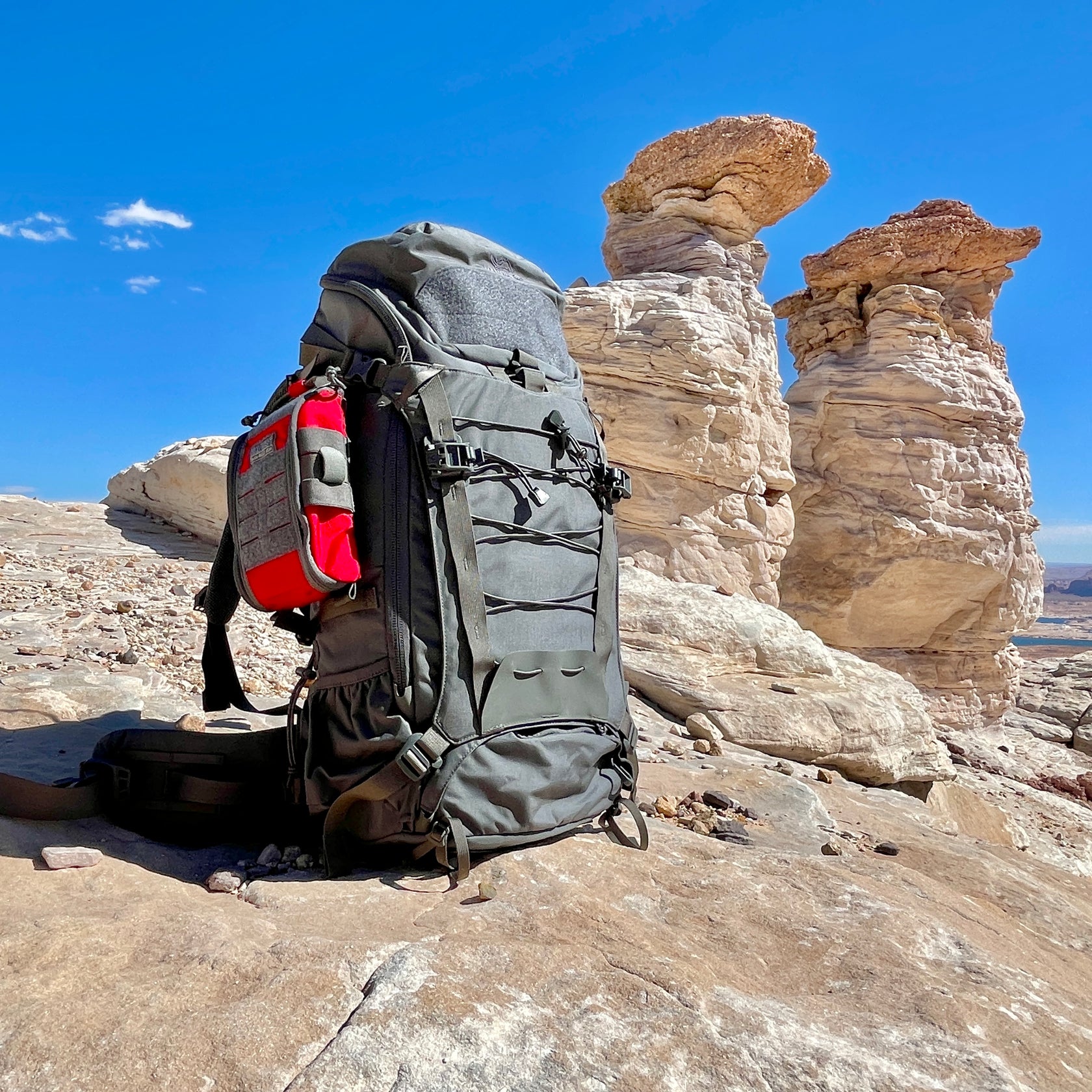
A hunter's IFAK needs to be waterproof, lightweight, and mountable to a pack — not just tucked in a range bag. Priorities shift in the field.
Threats you actually face in the field
Accidental gunshot wound
The #1 cause of hunting fatalities. Whether from a misfire, stumble, or shared camp — arterial bleeding from a GSW to the leg or torso requires immediate tourniquet application and wound packing. Every second counts.
Broadhead / knife laceration
Field dressing a deer with a razor-sharp broadhead or boning knife is one of the most common causes of serious hand and arm lacerations in hunters. Deep cuts to the palm or wrist can sever tendons and arteries.
Chainsaw or treestand fall
Treestand falls are responsible for more hunting injuries than accidental discharges. Falls from 10–20 feet cause fractures, spinal injuries, and internal trauma. A SAM splint and compression wrap are essential.
Penetrating chest wound
Any penetrating chest trauma — from a firearm, broadhead, or fall onto a sharp object — risks pneumothorax. A vented chest seal applied within minutes prevents a tension pneumothorax from becoming fatal.
Hypothermia / exposure
Blood loss accelerates heat loss dramatically. A trauma patient in 50°F weather who is also losing blood will go hypothermic fast. A mylar blanket costs nothing in weight and can prevent the lethal triad from completing.
Snake bite / allergic reaction
In the field, anaphylaxis from bee stings or snake envenomation requires immediate response. If you or your hunting partner has a known allergy, an EpiPen belongs in the kit. Always call for evacuation — this is a hospital emergency.
MARCH-PAWS for hunters
Military special operations use MARCH-PAWS — adding Pain management, Antibiotics, Wounds, and Splinting to the standard MARCH sequence. For backcountry hunters operating hours from definitive care, this extended protocol reflects the reality of prolonged field care. Your kit should cover at minimum the MARCH phases.
What your hunter's IFAK needs
Essential components — carry on your body
On-body IFAK
Combat Application Tourniquet — C-A-T Gen 7
Limb hemorrhage control — M phase
QuikClot Combat Gauze — 3" x 4 yards
Wound packing / junctional bleeding — M phase
Emergency Trauma Dressing (ETD) — 4"
Pressure bandage / wound cover — M phase
HyFin Vent Chest Seal — Twin Pack
Penetrating chest trauma — R phase
Nasopharyngeal Airway (NPA) — 28Fr
Unconscious airway management — A phase
Mylar Emergency Blanket
Hypothermia prevention — H phase
Nitrile Gloves — 2 pair
Blood-borne pathogen protection
Trauma Shears — ONE SHEAR® or equivalent
Clothing exposure / access
Pack additions — basecamp or day pack
Extended kit
SAM Splint — 36"
Fracture immobilization — C phase
Second C-A-T Tourniquet
Multiple casualty / backup
Compressed Gauze — 4.5" x 4.1 yards
Additional wound packing
Medical Tape — 3" cloth
Dressing fixation, improvised splinting
Permanent Marker
Tourniquet time notation (T: ____)
Compact vs full kit — which do you need?
| Scenario | Recommended kit | Tourniquet | Chest seal | SAM splint | NPA |
|---|---|---|---|---|---|
| Day hunt — <1 mile from road | Compact IFAK | Yes | Yes | Optional | Optional |
| Pack hunt — 5+ miles in | Full IFAK + pack additions | Yes x2 | Yes | Yes | Yes |
| Group hunt — 3+ people | Individual IFAK per person | Yes each | Yes each | 1 shared | 1 shared |
| Overland / camp vehicle | Vehicle & Home kit + IFAK | Yes | Yes | Yes | Yes |
Shop UMG kits for hunters
Best for day hunts
Compact IFAK Kits
Lightweight, mountable, and stocked with essential hemorrhage control. Clips to a pack shoulder strap or belt. Compact enough to forget it's there until you need it.
Shop Compact Kits →
Best for backcountry / overland
TRK-1 Trail Response Kit
Our purpose-built overland and backcountry trauma kit. Larger format, fully MARCH-stocked, built for hunters who spend days in the field far from help.
Shop TRK-1 →
Build your own
M — Hemorrhage Components
C-A-T tourniquets, hemostatic gauze, ETDs, and pressure bandages. Source exactly what you need, in the quantities you need. NAR-verified components only.
Shop Components →
Custom configured
Build My IFAK Bundle
Select exactly the components that match your hunt. Choose your pouch, your tourniquet model, your gauze type. No kit tax — pay for what you actually need.
Build Your Kit →
Frequently asked questions
Yes — if you're carrying a firearm. Any penetrating chest wound from a GSW or broadhead risks pneumothorax. A vented chest seal takes up almost no space and weighs nothing. It's one of the highest-value components in any field kit. The HyFin Vent is the NAR standard and what's in every UMG kit that includes one.
Yes — with practice. The C-A-T Gen 7 is specifically designed for self-application with one hand. Train with it before your hunt. A tourniquet you've never practiced with is significantly harder to apply under stress. Stop the Bleed courses teach self-application in about 20 minutes.
On your body — not your pack. If you have to ditch your pack in an emergency, your kit goes with it. A compact IFAK on your belt or vest shoulder strap is always accessible. Keep a larger kit in your pack or basecamp for extended care, but the essentials need to be on you at all times.
The Vanquest FATPack pouches used in most UMG kits are water-resistant and built for field use. For truly waterproof storage in rainy or wading conditions, consider keeping components in a small dry bag inside your kit. Individual components like gauze and chest seals are sealed in their own packaging.
Many trauma care components qualify for HSA/FSA reimbursement depending on your plan. Email sales@urbanmedicalgear.com after purchase and we'll send an itemized receipt to submit for reimbursement.
Don't Hunt Unprepared
The field is unforgiving. Every hunter in your party should carry their own kit — not share one. Stock up before season opens.
Disclaimer: This page is for educational reference only. Gear is not a substitute for training. Urban Medical Gear recommends completing a Stop the Bleed or TCCC course before deploying any trauma kit in an emergency. In any hunting accident, call 911 or activate a satellite communicator (Garmin inReach, SPOT) immediately — your kit buys time, it does not replace evacuation.